The Problem
Traditional social compliance audits were built for a different era of supply chain oversight. Many rely on broad checklist methodologies, limited auditor discretion, and supplier-paid commercial models — a structure that weakens independence and makes it easier for the issues that matter most to go unseen. The result is a familiar pattern: a passing report that does not reflect what workers actually experience on the floor.
At the same time, the ground brands stand on is shifting fast. Mandatory human rights due diligence laws — the EU Corporate Sustainability Due Diligence Directive, the U.S. Uyghur Forced Labor Prevention Act, Germany’s LkSG, and others — are moving the bar from “did you audit” to “can you show credible, evidence-based due diligence.” A clean checklist score no longer protects a brand, and it never protected the worker.
Brands need an assessment they can actually stand behind: independent of the factory relationship, focused on the risks most likely to cause serious harm, and rigorous enough to hold up under scrutiny from a regulator, an NGO, or their own board.
Our Approach
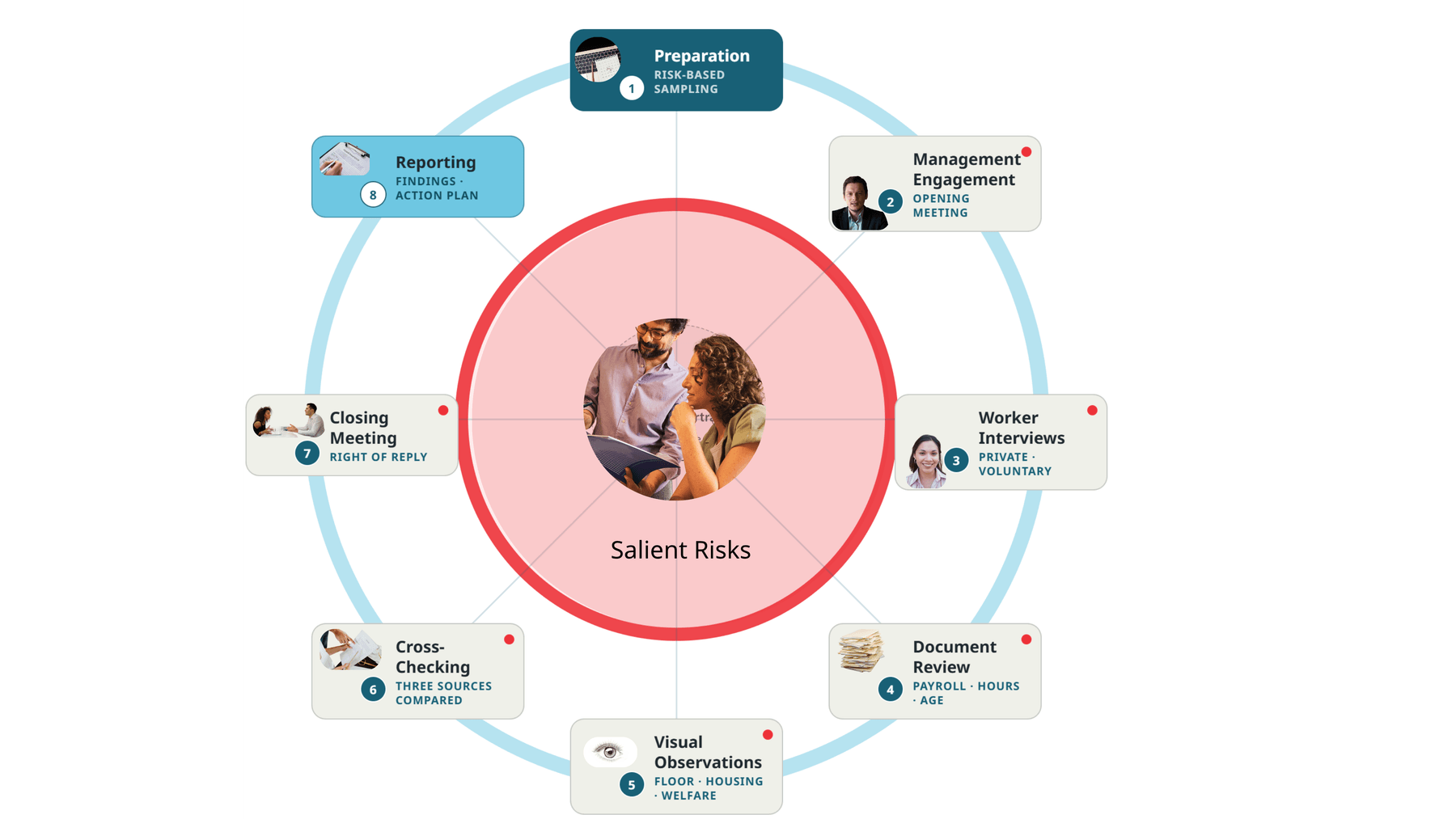
The Salient Risk Supplier Assessment (SRSA) is Mosaic’s answer to an industry in transition. It keeps the parts of a traditional audit that work — document review, facility tour, management interviews — and rebuilds the rest around independence, investigative rigor, and evidence that can withstand real scrutiny.
- Independent by design. We only do brand-directed assessments. Mosaic does not market audits or outcomes to factories, which removes the conflict of interest baked into legacy scheme models like SMETA, BSCI, WRAP, etc.
- Prioritize salient risks. Rather than treating every issue equally, the SRSA prioritizes what is most associated with serious harm and regulatory scrutiny — forced labor, migrant worker abuse, wage and hour violations, harassment, freedom of association, critical health and safety risks, and the weak management systems that let these recur.
- Investigative and professional. Our auditors go beyond checklist verification, with the training and latitude to dig deeper wherever a red flag emerges — in an interview, a document, or something observed on the floor.
- Worker-centered evidence. Findings are built from confidential worker interviews, management interviews, payroll and time record review, visual inspection, and, where appropriate, technology-enabled worker voice — not a single checklist pass.
- Improvement focused. Findings are written with the goal of identifying root causes and to facilitate measurable improvements.
Assessment Types
Unless a client requires otherwise, we use Mosaic’s assessments follow a modified version of the ILO Better Work Compliance Assessment Tool (CAT) and covers core international labor standards and applicable national laws recognized by regulators.
Across every assessment type, six components are always included and never skipped: the opening meeting, confidential worker interviews, the facility tour, document and record review, data analysis and cross-checking, and the closing meeting. Time allocated to each can expand or contract with context — but the core discipline does not.
Who’s If For
Our assessments are built for brands and retailers ready to move from a generic compliance audit to a defensible, risk-based due diligence program — particularly those with global supply chains, board-level exposure to sourcing risk, and a genuine need for findings that hold up under outside scrutiny.
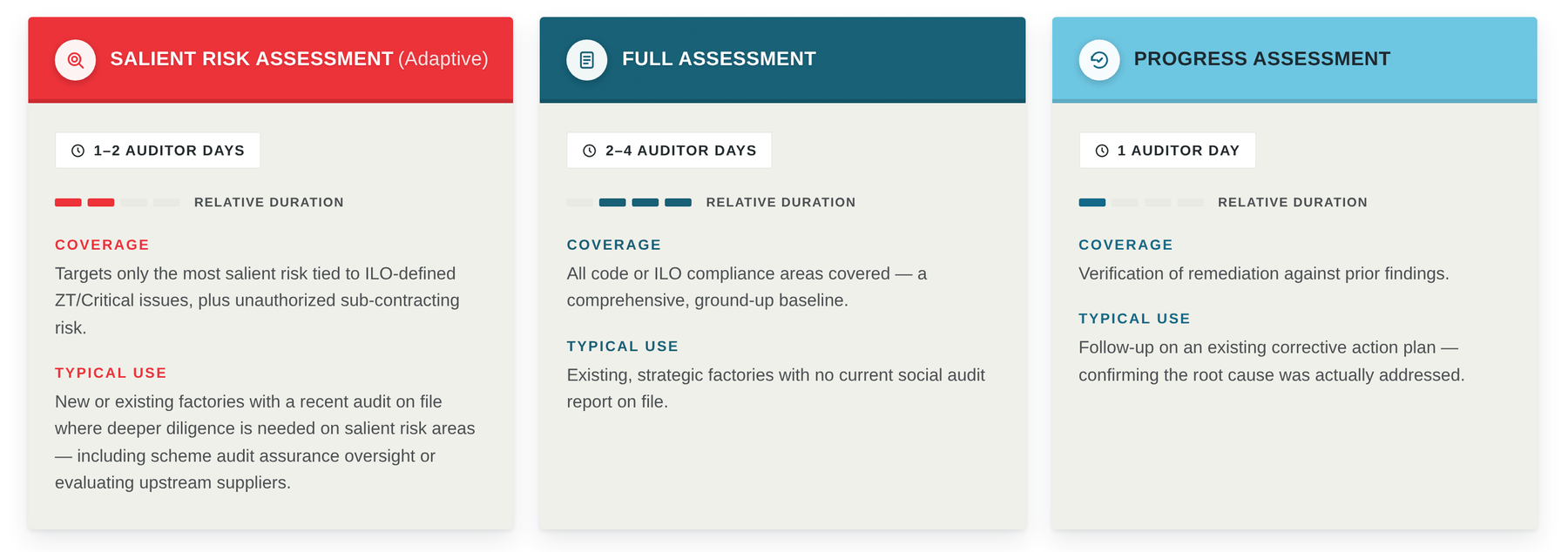
- Onboarding a new factory: a ZT/Critical Issues Assessment gives you a fast, rigorous read on the highest-stakes risks before product ever ships.
- An existing, strategic factory with no current audit on file: a Full Assessment covers the complete DAT for a comprehensive baseline.
- An existing, strategic factory with a current untrusted “clean” scheme (SMETA, BSCI, Certification, etc.) report on hand: a Salient Risk Assessment (Adaptive) delivers deeper diligence exactly where it’s needed, without re-covering ground already known.
- A facility already under a corrective action plan: a Progress Assessment verifies whether remediation actually addressed the root cause — not just whether the paperwork says it did.
FAQ
How is the program more independent? It is brand-directed. It avoids supplier-funded models to eliminate conflicts of interest.
Which salient risks are covered? Severe harm areas: forced labor, migrant abuse, wage theft, harassment, and unsafe conditions. Issues all aligned with ILO ZT/Critical indictors.
What does an investigative approach mean? Assessors look beyond checklists. They dig deeper into interviews and data when red flags emerge.
What is worker-centered evidence gathering? It prioritizes worker confidentiality, direct worker-management dialogue, and tech-driven worker input.
What is non-triangulated intelligence? Documenting credible, qualitative warning signs that need follow-up, even without immediate, hard proof.
Who are Mosaic’s assessors? Extremely experienced, high-integrity experts incentivized for competence under an independent model. Ask us for our team profiles.
What standards and protocols are used?
Core ILO standards, local laws, and a modified ILO Betterwork Compliance Assessment Tool (CAT).
What is the real value to brands? Clearer risk visibility, early warnings, and legally defensible, regulator-approved remediation.
What countries offer SRSA? USA, Mexico, Central America, Brazil, Turkey, China, Taiwan, Vietnam, Malaysia, Thailand, Cambodia, India, Bangladesh, Sri Lanka, Pakistan.